

Reflections on Ecstatic Birthing
for women who want the whole story

I closed my eyes and reclined slightly in bed, letting the weight of my full belly rest in the pillows for a few precious minutes. The baby kicked, raised bumps dotting my belly as I imagined the upcoming labor, breathing and consciously relaxing every part of my body.
I’d taken a few minutes to rest, relax, and imagine the birth every day for the last several weeks. Today, I knew things were shifting.
Much later, after putting the kids to bed and turning in early myself, I awakened to make an all-too-common nighttime bathroom visit. I felt the wave press over me, hugging my baby and my belly. It was long, longer than the toning waves I’d been feeling for weeks now. Crawling back into bed, I felt more, and eventually couldn’t stay in bed. I got up, leaned forward over the bathroom counter, and swayed my hips with the coming rushes.
I knew the baby was on the way, and I was ready to embrace the beautiful work of birthing a new soul.
The Seeds of Ecstatic Birth
There is a reason that labor often comes on in the quiet darkness of night. Sometimes it comes suddenly, with a splash of fluid and contractions that pull and squeeze, heralding the baby’s upcoming arrival with certainty.
But often it builds slowly, arriving in your consciousness as you rise in the night and realize that things are different, that sleep may not come.
Labor builds slowly but surely, fueled not by due dates or wishful thinking, but riding on a rich symphony of hormones invited by the quiet of the night and a mother’s love.
These still moments of dawning realization seed an ecstatic birth. Your own hormones guide the process from start to the joyous finish of your baby in your arms - even through the much softer arrival of the placenta. Hormones guide the continued dance of the womb, as it rhythmically squeezes down to a fraction of the size, keeping you safe even as you immerse yourself in deep love for your baby.
This hormonal blueprint is the key to a powerful, ecstatic birth. It’s simultaneously a fragile orchestra. Interruptions such as rushed car rides, endless check-in protocols, and constant monitoring break the hormonal flow down, resulting in slowed labor and, often, “failure to progress.”
Induction or augmentation of labor completely short-circuit your hormonal helpers. The synthetic hormones used in these procedures flood your body, causing the mechanical effect of contractions but failing completely to pass into the brain… the place where your own hormones stimulate natural pain relief…
…plus a potent bath of ecstatic feelings and deep bonding upon holding your baby.
Should We Even Be Talking About This?
There are many that want women to shut up and stop talking about ecstatic birth. Doctors, and especially insurance companies, want birth to go a certain way. Controlled. Monitored. Predictable.
A docile, drug-controlled labor allows them to deliver an end product (a “healthy baby”) and meet their profit margins at the same time.
The baby, not the woman’s experience, not optimal health for mother and child, is all they need to deliver to get their dollars.
Many women don’t want to talk about ecstatic birth, either. It doesn’t match their experience, and the ever-present undercurrent of mom-guilt may cause overt hostility to something that seems to offer benefits they didn’t enjoy with their own babies.
Sometimes there’s a deep fear - outside forces, like a doctor, do not control this ecstatic birth. Instead, it’s a woman’s own body, her wisdom, her dance with her baby that bring forth life.
That is the very birthplace of power - to realize she can bring forth life.
There may be a mentor or guide, but birth is not a controlled process. It could go wrong. Ecstatic birth seems not only improbable but also “selfish” in our current world of medically managed childbirth.
The books, TV, and movies portray birth as an agonizing danger, after all. Even the modern news narratives emphasize that this is a dangerous, potentially tragic time.
How is there room for talk of ecstasy amidst a sea of fear, guilt, and the need to run a profitable maternity ward?
Ecstatic Birth is Safer Birth
This is precisely why we do need to talk about this. While birth is unpredictable, and sometimes mamas and babies do need lifesaving help, birth is not as fraught with danger as women are led to believe. There are steps you can take during pregnancy to have a safer birth…
…and an ecstatic birth is a safer birth.
Why?
Because your body is not stupid. I often say it doesn’t matter your belief system - evolution or a birthing symphony composed by God - the point is, birth is designed to work.
Your body has the wisdom within to grow your baby from a single cell into a beautiful child.
It has the wisdom - and the hormonal blueprint - to safely birth that child.
It has the wisdom to birth and immediately bond with that baby in a powerful rush of excitement, joy, and love.
Why? Because a mother who feels joyful, excited, vibrant, powerful, and in love with her baby is at an advantage. Her baby is at an advantage. She desires to - and is able to - care for her baby. Every “mama bear” instinct is immediately on fire, and she crashes headlong into complete devotion to this new little soul.
That is what’s best for both mama and baby.
Okay, But Surely I Can’t Have One of THOSE Births?
Many pregnant mamas believe “that woman” can have one of those births - but you may not believe you can.
It seems ridiculous to think of birth as something joyful and ecstatic, especially when you see awful (or ridiculous) birth scenes, hear awful stories, and have even grown up reading books with crappy birth outcomes.
And what about history? Women and babies really had complications during birth - a lot.
Not to mention thinking about birth in any sort of joyful or, heaven forbid, pleasurable way seems taboo and maybe even a little icky.
On top of that, you may be scared of pain, uncomfortable with your body, and overall completely certain that you’re just not cut out for this.
I can (and actually, I have) spent hundreds hours addressing all of those points in my posts, podcasts, and courses. There are valid considerations (like what’s different now compared to historical birthing conditions). There’s prractical learning to do…
…though I encourage you to simply let go of some of those points (sensationalistic Hollywood birth scenes? Gone!)
What I want you to most understand is that birth is designed to work.
Birth is not just a random collection of contractions riding on luck. This is not a “wing and a prayer” process anymore than digesting your next meal is. You don’t doubt your body’s ability to handle the complexities of breathing and oxygenating your tissues.
You don’t even really doubt your body’s ability to grow your baby.
It’s just happening. According to a blueprint.
There is a blueprint - a hormonal symphony - that controls labor and birth. It has a purpose beyond just spitting a baby out.
It’s designed to birth your baby at the perfect time for his or her development
It’s designed to maximize your love and adoration for your baby, so you’ll want to cuddle, protect, and cherish him or her
It’s designed to bond you closely so you’re frequently holding your baby, nursing your baby, and checking on your baby
Agonizing, protracted births don’t benefit mother and child. They are not part of the design of birth.
We’re coming off of a century of doctors messing with birth, even to the extreme of knocking women out and dragging babies out with forceps. Doctors backed off of that barbarism after significant backlash - but they never relinquished the idea that they need to “control” birth. It’s significant that those studying the actual, undisturbed hormonal process of labor and birth are mostly mothers (Dr. Sara Buckley’s work is an example).
Even typing all of this out sounds more academic, clinical, theoretical. But, as I said above, I want you to understand that your body, your baby, YOU have the innate blueprint within to birth your baby joyfully.
What if It Doesn’t Work?
Yes. There are times it doesn’t work this way.
I often have women angrily point this out to me on social media, assuming, I suppose, that I’m an idealistic newbie just converted to being a natural birth True Believer.
I do have a completely realistic view of the power of women and their bodies to grow and bring forth their babies in joy - if that’s idealism, I’ll claim it any day.
But I’ve been on this block for a long time - almost a quarter of a century, now that I calculate it (that’s rather sobering, on a level, hah!).
I’ve had eight pregnancies, birthed eight children, myself. And I’ve taught, counseled, and coached hundreds of women through their pregnancies - women giving birth in all kinds of circumstances.
Sometimes birth doesn’t go smoothly. Sometimes, a mother and baby need help. Sometimes medical interventions, procedures, and protocols are lifesaving.
But there are many times when medical interventions, procedures, and protocols were superfluous or even harmful.
We Don’t Tell Women the Truth
I give lip service to “every woman should choose the right birth for her,” but if the only thing we portray about pregnancy and birth is how they’re so terribly dangerous, painful, and messy, we’re shortchanging women (to say the least).
Today, the narrative is even more dire. Abortion proponents have rallied around just how awful and dangerous even pregnancy is because they think that belief advances their cause.
In our desperate push to neutralize and equalify (is that a word?) our world, we’ve shared far and wide that pregnancy = a mental/emotional/professional death knell to women.
There is no unbiased, clear view of ecstatic birth because the medical establishment is almost completely ignorant of it and actively destroys the body’s own orchestration of a safe, successful birth.
Media and societal messages about birth are negative at best, and absolutely toxic at worst.
So before we talk about why ecstatic birth “doesn’t work,” we must address how a sensationalistic, profoundly negative lens colors nearly every aspect of modern fertility, pregnancy, and childbirth.
The actual, normal process of birth is almost never talked about, except to shame and “other” the women who speak out about it.
This is What’s REAL About Childbirth
What we know is that women who prepare for an undisturbed birth, who advocate for themselves and their babies, and who focus on evidence-based nutrition and other healthy pregnancy steps are more likely to have a good labor and birth…
…they are more likely to feel empowered and satisfied even if they need medical assistance during the birth. Women who are proactive and feel heard, respected, and part of the decision-making may grieve the loss of a “perfect birth,” but they process that and feel, overall, satisfied.
I’ve helped many women process difficult birth experiences, and see first-hand the difference between a woman who felt bullied and forced into interventions and a woman who realized the intervention was necessary and stayed the active decision-maker throughout the whole process.
Why We Need to Let the Secret Out
All thoughts and planning went out of my head as I leaned forward against the bathroom counter, my hands planted firmly and my hips loose. I swayed and rolled them through the rushing contractions, a sense of flow coming over me.
With this baby, my sixth, I knew to welcome to rushes, to let the moans ripple across my lips, woven together with prayers that God would bring this little one safely to my arms.
Invisible yet oh-so-palpably, my brain directed hormones into action, bringing the waves and my baby ever-closer.
I shed my clothes and moved quickly between contractions to the birth tub. I started shivering, not because I was cold, but because adrenaline added into the swirl of hormones as the birth drew close.
At some point my midwives arrived, but I was on another plane, in the timeless place of transcendence that so many women speak of…
…in my mind’s eye I could see my baby. I walked, flew, danced along a path to take this child, to bring this child back with me. I felt the baby’s head begin to move down and there was no pain, just golden & blue light streaming before his head as my body pushed, his tiny feet pushed, and I birthed him into my arms.
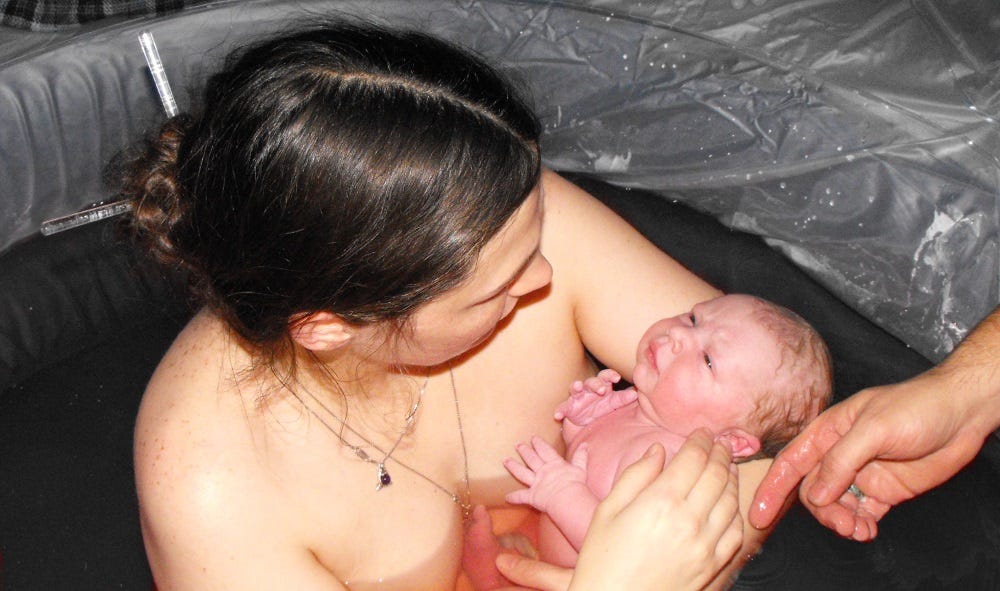
He slipped into the world silently, riding a wave of gold and pleasure. Birthing him was so peaceful that even my midwife didn’t realize he was born, jumping when she saw me bring him out of the water and nestle him up by my breasts.
Those moments linger in my mind, years later. His birth was so sweet, joyous. All of the children were awake for that birth, surrounding me and looking on their baby brother…
…it was such a blessed way to welcome a new soul to the planet, both for me and for my new baby.
This arrival is the birthright of every newly born baby, every newly born mother. This hormonal flow, this dance, this journey into a place of timelessness to bring back your baby is every mamababy’s birthright.
It’s time we talked about ecstatic birth - why it can happen, what it looks like, and how it can happen.
Believe, gentle and fierce mama, that ecstatic, joyful birth is for you and your baby, too.
I love this - shared it straight away with a friend who's expecting her first. Such beautiful powerful writing. I'm a veterinarian and it seems mad that we treat humans so differently from animals. I'd never suggest someone brought their dog to hospital to give birth. If a foaling mare stopped birthing because I disturbed her, I'd blame myself, not her. Yet we always blame women and women's bodies.
Thank you for a glorious piece, that helped me revisit my three wonderful home births. My children always want to hear their birth stories because they were a part of those magical days.
Oh my goodness, beautiful article!! I love the term “ecstatic birth.” Our fifth baby was a free birth and after my one hour labor, I was laughing and shrieking with JOY! That’s what woke my other children up. My daughter tells people now “I woke up because my mama was so happy she just had a baby! She was SOOO HAPPY!” I’m like what a core memory for her, wow.